Your TrueTone Profile
Your TrueTone Profile is the fingerprint of how you communicate. You build it once in a short interview with Tru, and every piece of content the system generates leans on it to sound like you instead of a generic template.
What it is
The TrueTone Profile is a structured picture of your voice: the words you reach for, your rhythm, how much detail you give, how warm or formal you are, and the phrases and stories that are yours. The system reads this profile every time it drafts a blog post, email, social caption, video script, or audiogram, so the draft starts from you rather than from a blank, average tone.
It has two parts. The first is eight traits: dial-style settings that describe your communication style at a glance. The second is six deeper layers that the analysis deduces from what you actually say, things like your persona, your background, and the natural phrases behind how you talk. Together that is a compact, honest profile, not thirty abstract dimensions you have to babysit.
If you record your voice, the profile also includes a private voice model: a clone of your voice used to narrate audio content. That is what lets audiograms and blog audio sound like you and not a stock narrator.
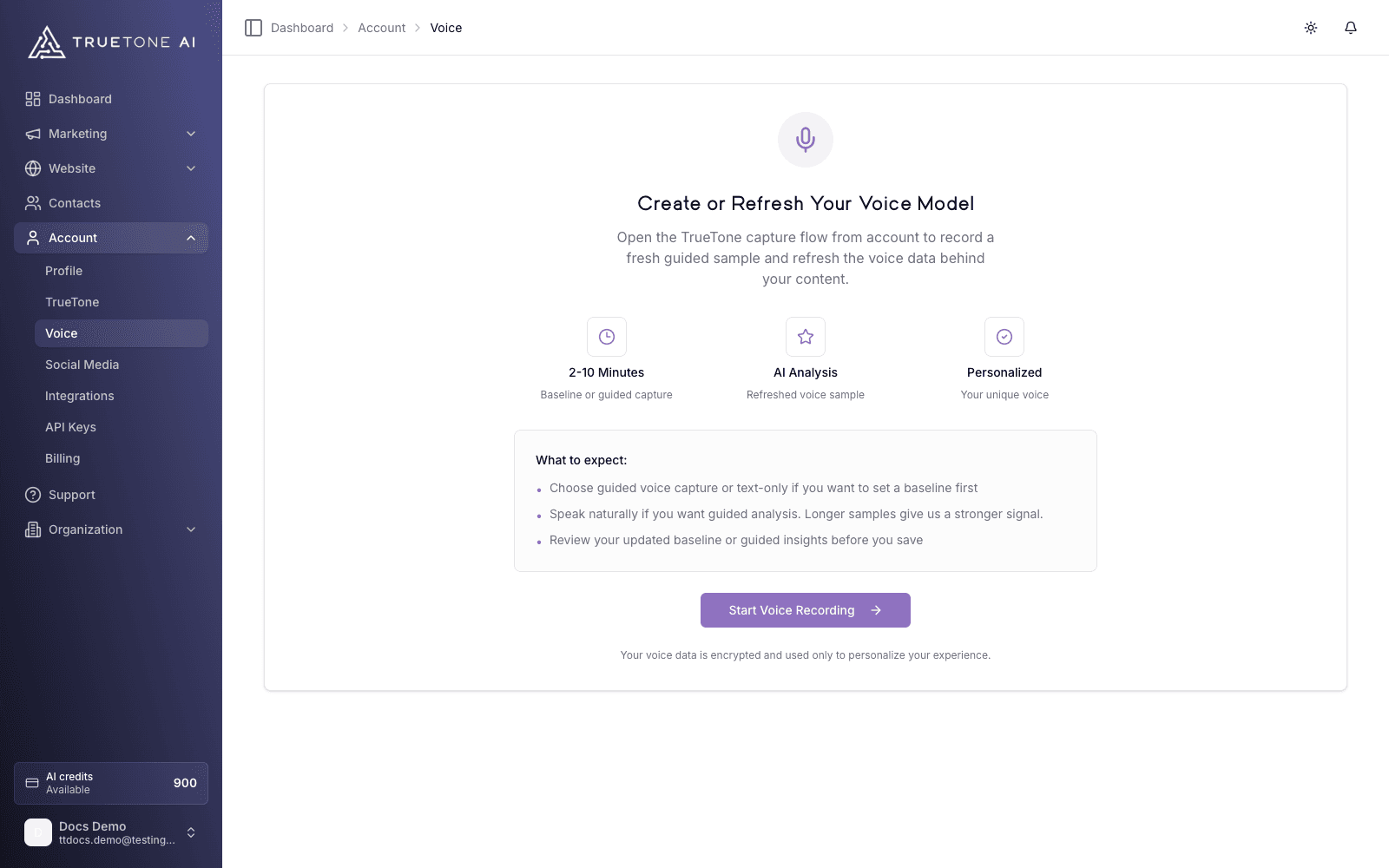
You build and manage all of it in one place, in your Voice settings under Account.
Who it’s for
Every loan officer has one, and it is worth doing well, because it is the single input that most affects whether generated content sounds like you. The stronger the profile, the less editing you do later. Sales, marketing, and product reference this page when they need to explain what the profile actually is and how it gets built.
How you build it
There are three setup paths. Two use your voice and create a voice model; one is text only. Pick the one that fits the time and the microphone you have right now. You can always come back and add voice later.
AI Conversation
Best results. About 2 to 5 minutes. You have a natural back-and-forth with Tru, your interviewer. Tru asks a question, listens, and adapts the next question to what you just said. This captures the most nuance: your rhythm, your word choices, your natural expressions. It creates your voice model and produces the fullest profile.
The Tru interview, step by step
Pick your setup path
Choose one of the three options above. A short intro screen introduces Tru and sets expectations before anything records.
Meet Tru and start talking
Tru is your interviewer, and only your interviewer. There are no scripts and no right answers: you speak the way you would with a colleague. Aim for at least two minutes of your own speaking time; five minutes is the quality target and gives the strongest profile and voice model.
Speak naturally, and redo any take
You are never locked into a moment. You can pause and resume, and you can re-record a take you are not happy with before it counts. Say it your way.
Get your analysis after the session
When you finish, the analysis runs and your profile is delivered after the session. There is no live meter ticking as you talk. Once it is ready, you review your profile and your voice model.
The eight traits
These are the dials that describe your communication style. Voice paths infer them from how you speak; the text-only path lets you set them directly. You can adjust them anytime, and Tuning how you sound walks through how to nudge a trait or add written voice direction when a draft is close but not quite you.
| Trait | What it sets | Example options |
|---|---|---|
| Tone of voice | The overall feel of your writing | Professional, Friendly, Authoritative, Conversational, Empathetic |
| Formality | How buttoned-up or relaxed you sound | Ceremonial, Professional, Balanced, Relaxed, Casual |
| Humor | The style of wit, if any | Dry, Witty, Playful, Satirical, Absurdist |
| Emotional expression | How openly you show feeling | Stoic, Reserved, Balanced, Expressive, Passionate |
| Detail orientation | How deep you go on specifics | Essential, Overview, Balanced, Comprehensive, Exhaustive |
| Vocabulary | The reading level and word choice | Elementary, Accessible, Professional, Sophisticated, Specialized |
| Content length | How long your pieces tend to run | Minimal, Brief, Moderate, Thorough, Comprehensive |
| Engagement style | How you pull the reader in | Informative, Interactive, Narrative, Consultative, Inspirational |
The six layers
Under the traits sit six deeper layers that the analysis deduces from what you actually said, rather than from a dial you moved. They capture the substance the dials cannot, including your persona, your background, your overall tone, the natural phrases you reach for, the emotional anchors behind them, and your broader communication patterns. On the text-only path, these are inferred from your written answers instead of your speech.
Eight traits plus six layers is the whole schema. If you have seen an old spec claiming thirty dimensions, ignore it: the profile is deliberately compact so it stays honest and easy to reason about.
Your voice model
If you took a voice path, the interview also produces a private voice model, a clone of your voice. It is what makes audio content sound like you. From your Voice settings you can:
- Test it in the Test Studio, which generates sample audio so you can hear how you sound.
- Retrain it anytime by recording again, which refreshes the model and profile.
- Tune its output with voice settings (stability, similarity, style, speaker boost) that shape how generated audio is rendered.
- Delete it if you want to start over. Content generation that needs the model stops until you record a new voice, and your original recording is cleared from your account along with it, so starting over means recording again.
Good to know
The text-only path does not create a voice model, so audio features stay locked until you record. Audiograms in particular require a voice model. If you plan to make audio content, choose one of the two voice paths, or add voice later from your Voice settings.
Tru only runs the interview. Tru never writes your content. Content generation is a separate step that reads your finished profile; do not describe the interview as producing your posts.
The analysis is delivered after the session, not in real time. Nothing is scored or tracked live while you speak, so you can focus on talking naturally and review the results once they are ready.