Compliance checks on your content
A compliance check reviews a finished piece against mortgage advertising rules before it goes out. It gives you one clear outcome and a short list of findings, each with a plain explanation and, where possible, a suggested fix. Today these checks run in advisory mode and are rolling out channel by channel, so read the honest status near the end before you rely on one.
What it is
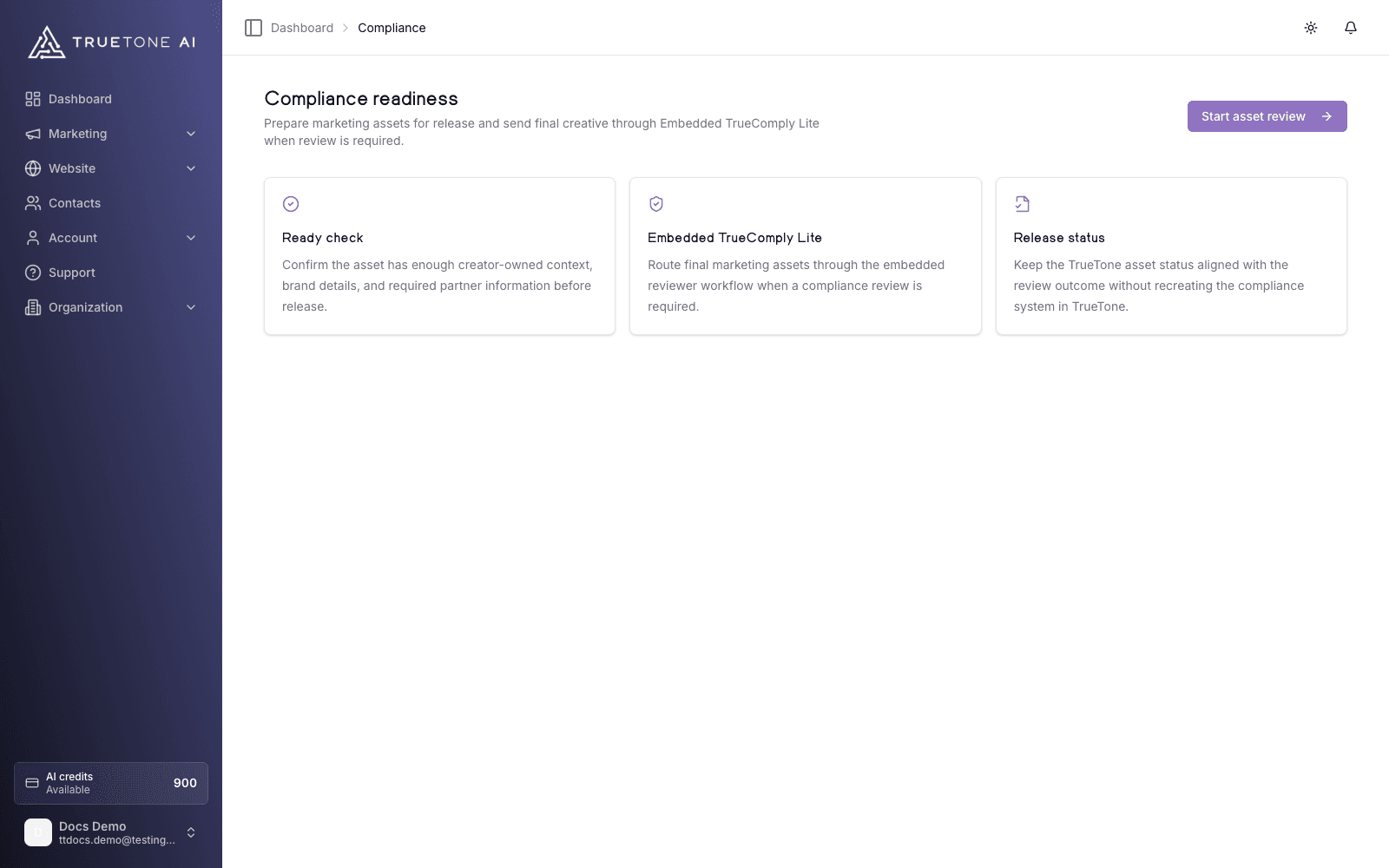
A compliance check is a review step. Before you finalize, schedule, publish, export, or share a piece, TrueTone can look at it and tell you whether anything in the wording is likely to draw a compliance objection. Think of it as a second set of eyes that knows the advertising rules, run in seconds instead of days.
There are two flavors, and which one you get depends on your account:
- A self-check is a review you run yourself. You see the findings, and you decide whether to make a change or explain why a flag is acceptable.
- A governed check is for enterprise seats. It works the same way, but warnings route to your organization’s compliance reviewer rather than being something you clear on your own.
Either way, the check does not send anything and does not change your content on its own. It reads what you have made, reports back, and leaves the next move to you.
Who it’s for
Every loan officer who publishes regulated content, which in mortgage is nearly everything. If you work inside a company that has turned on governed content, your checks route to a compliance reviewer automatically. If you are on your own account, checks are advisory: you run them for peace of mind before something goes out. In both cases you never author the rules. They are written by an actual compliance reviewer, so a check is not you grading your own homework.
What a check looks at
A check reads the meaningful parts of a piece rather than skimming the whole thing. For written content that means the headline, the body, the call to action, and any disclosures you have added.
Because it reads what is written, the quality of a check tracks the quality of what you give it. A piece with a clear disclosure and no exaggerated claims tends to sail through. A piece that leans on rate figures or program-specific claims, like VA or FHA guidelines, is the kind of thing a check is built to catch, and the kind of thing most likely to earn a warning or a required edit.
How it works
Run a check
Where a check is offered, you start it from the piece you are working on before you take a release action (finalize, schedule, publish, export, or share). Running a check does not spend your content credits.
Read the outcome
Every check returns one of three outcomes. This is the headline you act on, and it is recalculated every time the piece or its findings change, so an outcome always reflects the version in front of you.
| Outcome | What it means | What you do |
|---|---|---|
| Pass | Nothing needs changing. The piece is cleared for the action you were about to take. | Release it. |
| Needs review | There are warnings to work through, or (for enterprise seats) it is parked with your compliance reviewer. | Resolve the warnings, or wait for the reviewer. |
| Fail | There is at least one required edit that has to be resolved first. | Fix the flagged wording, then re-run the check. |
Work the findings
Below the outcome sits the list of findings. Each one names the issue, explains it in plain language, and often points at the exact wording. Many carry a citation to the rule behind the flag. Findings come in three levels:
| Finding | What it means | How you clear it |
|---|---|---|
| Note | A heads-up. Nothing is required. | Read it and move on. |
| Warning | Something worth a second look. | Accept a suggested fix, or (self-check only) justify why it is acceptable. |
| Required edit | Wording that has to change before release. | Edit the copy. A required edit can never be waived. |
Accept a fix or justify
For most findings TrueTone can offer a compliant rewrite of just that passage, one that stays in your brand voice and is re-checked against the rules before it is offered to you. Accepting it swaps the wording in place. If you would rather keep a warning as written, a self-check lets you justify it by writing a short note explaining why it is fine. Both actions are recorded, so there is a clear trail of who decided what and why.
Release when it clears
Once the outcome reads Pass (or your reviewer approves a governed piece), the release action you started with is available again and you can send the piece on its way.
If you edit the piece after it clears, the earlier outcome no longer applies to the new wording, so run the check again before you release. A check always speaks to the exact version it read.
Good to know
Compliance checks are staged, and this is the honest status. The framework is built and contracted, but it is rolling out channel by channel in advisory mode: today a check flags issues, it does not block your content. As your organization turns on enforcement for a given channel, checks on that channel begin to gate release. For your blog, email, social, video, and audiograms, coverage is arriving over time, so do not expect a check to be offered on every piece yet. Never assume a check has blocked something for you unless the outcome clearly says so.
Required edits are never yours to waive. A warning can be accepted with a fix or, in a self-check, justified with a note. But a required edit (a blocking finding) always means the wording has to change before the piece can be released, in every mode. There is no way to attest your way past one.
If you are an enterprise seat, warnings are not yours to clear. They route to your organization’s compliance reviewer, and you see the outcome, not who reviewed it. You will get a Needs review result until the reviewer approves or asks for changes. Justifying a warning yourself is a self-check feature.
Sometimes a check can only read part of a piece, usually when there is little text to inspect. When that happens the result is a limited review: the available wording was checked, but treat it as a spot check rather than a full clearance. If your organization’s compliance setup is still being finished, a governed piece may be held until an admin completes it. That last step is an org admin task.